Introduction
Dhul Khalasa was a prominent pagan sanctuary in pre-Islamic Arabia, known as the “Yemeni Kaaba.” People from several tribes of southwestern Arabia, including Khath’am, Bajila, and Daws, worshipped at this sacred house. It had an idol, temple custodians, rites of animal sacrifice, pilgrimage and circumambulation, and provisions for divination by arrows. Dhul Khalasa is an important historical example of the Kaaba-like sanctuaries and comparable pilgrimage rites that existed in Arabian society beyond the Kaaba in Mecca.
Muhammad sent Jarir ibn Abd Allah on a military expedition to destroy the sanctuary. Dhul Khalasa was torn down and burned, and the Islamic hadiths also record that people were killed in the raid. Muhammad prayed for the troops afterward. Earlier, at the conquest of Mecca in 8 AH, the pagan idols at the Kaaba had been removed. The structure itself and selected elements of its established pilgrimage rites were retained under Islam. At the Hajj of 9 AH, an announcement barred polytheists from performing Hajj from the following year onward. The destruction of Dhul Khalasa thus shows a clear process in which religious change went hand in hand with military force against a sanctuary used by other tribes and the concentration of authority over pilgrimage sites.
Hajj, the Kaaba, and Other Pilgrimage Rites in Pre-Islamic Arabia
According to Abd Allah ibn Mas’ud, there were 360 idols or stones that were worshipped around the Kaaba at the conquest of Mecca. Muhammad struck them with a stick he was holding and removed them, declaring that truth had come and falsehood had vanished. The Kaaba itself was not demolished. The existing pilgrimage site remained the central sanctuary of Islam, while worship of the old gods and the freedom of pagans to practise their religion there came to an end. (( Sahih al-Bukhari 2478: The 360 Idols Around the Kaaba ))
The Kaaba and such pilgrimage rites as Hajj, Umrah, circumambulation, entering the state of ihram, animal sacrifice, standing at Arafat and Muzdalifa, and reciting the talbiya were already established in Arabian society before Islam. Ibn al-Kalbi describes their pre-Islamic practice in the Kitab al-Asnam. He traces their origins to the legacy of Abraham and Ishmael. Alongside that religious account of their origins, he describes the pagan pilgrimage rites Arabs actually practised. The familiar rituals of Hajj were already part of the pilgrimage culture of seventh-century Arabia. (( Ibn al-Kalbi, Kitab al-Asnam: Pre-Islamic Arabian Pilgrimage and Worship ))
من تعظيم البيت والطواف به والحج والعمرة والوقوف على عرفة ومزدلفة وإهداء البدن والإهلال بالحج والعمرة – مع إدخالهم فيه ما ليس منه
English translation: Revering the Sacred House, circumambulating it, performing Hajj and Umrah, standing at Arafat and Muzdalifa, offering sacrificial animals, and making the ritual proclamation for Hajj and Umrah were all practices among them. They also added rites that were not part of the original prescription.
Different Arabian tribes built temples for their own gods, set up stones and idols, circumambulated them, and offered animal sacrifices. Ibn al-Kalbi writes that some Arabs took stones from the sacred precinct of Mecca to distant places, set them up, and walked around them. Those without the means to build a permanent sanctuary or make an idol could select a stone, treat it as sacred, and circumambulate it. The Meccan Kaaba was an important centre in this wider religious landscape. It was one of several places where people circumambulated stones and made offerings. (( Kitab al-Asnam: Sacred Stones, Idols, Circumambulation, and Sacrifice Among the Arabs ))
The social and religious authority of the Quraysh of Mecca was also bound up with the pre-Islamic Hajj. In Sahih al-Bukhari 1665, Urwa ibn al-Zubayr gives details about naked circumambulation of the Kaaba and the special privileges of the Quraysh. The Quraysh and their descendants, known as the Hums, claimed a special status for their ritual garments. Some pilgrims from other tribes circumambulated in clothing supplied by the Hums; those who could not obtain such clothing might circumambulate naked. The Quraysh also differed from other Arabs in where they stood at Arafat and Muzdalifa. Ordinary pilgrims set out from Arafat, while the Hums remained at Muzdalifa. Long before Muhammad, the Meccan Hajj was already a religious institution with a pilgrimage route, rules about clothing and ritual, and distinctions based on tribal rank and ideas of sanctity. (( Sahih al-Bukhari 1665: Pre-Islamic Circumambulation, the Hums, Arafat, and Muzdalifa ))
كَانَ النَّاسُ يَطُوفُونَ فِي الْجَاهِلِيَّةِ عُرَاةً إِلاَّ الْحُمْسَ، وَالْحُمْسُ قُرَيْشٌ وَمَا وَلَدَتْ
English translation: In the Age of Ignorance, people circumambulated naked except for the Hums. The Hums were the Quraysh and their descendants.
The history of the sa’i between Safa and Marwa also provides direct evidence of pre-Islamic religious practice. According to Aisha in Sahih al-Bukhari 1643 and 4495, some of the Ansar had entered ihram for the deity Manat before they accepted Islam, and Safa and Marwa figured in their religious practices. In Sahih al-Bukhari 4496, Anas ibn Malik says that they regarded going between Safa and Marwa as a custom of the Age of Ignorance. When Islam came, they stopped performing the rite. Quran 2:158 later declared Safa and Marwa to be among the signs of Allah. An already familiar pilgrimage rite thus received a new religious sanction. The worship of Manat died out, but the sa’i between Safa and Marwa remained part of Hajj and Umrah in Islam. This makes clear what was kept and what was discarded from ancient Arabian religion: some gods and idols were destroyed, while many of the same communities’ pilgrimage rites were preserved under a new religious authority. (( Sahih al-Bukhari 1643 )) (( Sahih al-Bukhari 4495 )) (( Sahih al-Bukhari 4496 )) (( Surah al-Baqara 2:158 ))
كُنَّا نَرَى أَنَّهُمَا مِنْ أَمْرِ الْجَاهِلِيَّةِ، فَلَمَّا كَانَ الْإِسْلاَمُ أَمْسَكْنَا عَنْهُمَا
English translation: We used to regard this rite between Safa and Marwa as a practice of the Age of Ignorance. So when Islam came, we stopped performing it.
The wording of the talbiya also varied among Arabian tribes. Ibn al-Kalbi records that the Nizar added a reference to another deity to the invocation “Here I am, O Allah, here I am.” On the pilgrimage of the Akk tribe, two enslaved boys at the front recited the tribal talbiya, and the others answered them. In Sahih Muslim, Ibn Abbas reports that the polytheists circumambulating the Kaaba would first say, “Here I am; You have no partner,” and then add, “Except for a partner who belongs to You.” Muhammad’s talbiya retained “Here I am” and “You have no partner” and dropped the exception. The familiar invocation of the same pilgrimage rite survived, but its religious message changed. (( Kitab al-Asnam: Pre-Islamic Talbiya and Tribal Pilgrimage )) (( Sahih Muslim 1185: The Polytheists’ Talbiya During Circumambulation of the Kaaba )) (( Sahih Muslim 1184a: Muhammad’s Talbiya ))
The polytheists’ first statement: لَبَّيْكَ لاَ شَرِيكَ لَكَ
Their next statement: إِلاَّ شَرِيكًا هُوَ لَكَ تَمْلِكُهُ وَمَا مَلَكَ
Muhammad’s talbiya: لَبَّيْكَ اللَّهُمَّ لَبَّيْكَ لَبَّيْكَ لاَ شَرِيكَ لَكَ لَبَّيْكَ
English translation:
The polytheists’ first statement: Here I am; You have no partner.
Their next statement: Except for a partner who belongs to You. You own him and all that he owns.
Muhammad’s talbiya: Here I am, O Allah, here I am. Here I am; You have no partner; here I am.
After the conquest of Mecca, control of the existing pilgrimage system changed hands. The Islamic authorities kept the Kaaba but abolished the right of its former pagan worshippers to perform Hajj there according to their own beliefs. At the Hajj of 9 AH, heralds sent under Abu Bakr’s leadership announced that from the following year no polytheist could perform Hajj and no one could circumambulate the Kaaba naked. Sahih al-Bukhari 1622 and Sahih Muslim 1347 preserve this order. The announcement made access to the pilgrimage site contingent on religious identity. A central sanctuary built and administered for generations by the earlier pagans remained standing, while the people of that tradition lost the right to practise their own rites there. The Kaaba survived. Its old idols were destroyed, its old gods were banished, and their worshippers were barred from taking part in its rites. (( Sahih al-Bukhari 1622: Polytheists Barred from Hajj )) (( Sahih Muslim 1347: Polytheist Pilgrimage and Naked Circumambulation Prohibited ))
أَلاَ لاَ يَحُجُّ بَعْدَ الْعَامِ مُشْرِكٌ، وَلاَ يَطُوفُ بِالْبَيْتِ عُرْيَانٌ
English translation: Hear this: after this year no polytheist may perform Hajj, and no one may circumambulate the Sacred House naked.
Alongside the consolidation of religious authority at the Kaaba, campaigns were carried out to destroy the sanctuaries of al-Uzza, al-Lat, Manat, and other deities. These sanctuaries had their own tribal worshippers, temple custodians, and sacrificial rites. The removal of their idols and temples destroyed the principal sites of the earlier local systems of worship. Dhul Khalasa was an important target of this military campaign. (( Ibn al-Kalbi, Kitab al-Asnam: The Destruction of Arabian Sanctuaries ))
Dhul Khalasa
The name Dhul Khalasa (ذو الخلصة) was used for the idol, the sanctuary that housed it, and the associated sacred site. Ibn al-Kalbi’s Kitab al-Asnam describes the idol as a white stone carved with a crown-like pattern. Yaqut al-Hamawi preserves this description in his Mu’jam al-Buldan. A permanent sanctuary and regional pilgrimage site grew up around the idol at Tabala. (( Ibn al-Kalbi, Kitab al-Asnam: The Identity of Dhul Khalasa )) (( Yaqut al-Hamawi, Mu’jam al-Buldan: Al-Khalasa ))
وكان من تلك الاصنام ذو الخلصة، وكان مروة بيضاء منقوشةً، عليها كهيئة التاج. وكانت بتباله بين مكة واليمن …
English translation: Dhul Khalasa was among those idols. It was a white stone with a pattern like a crown carved on it. It stood at Tabala, between Mecca and Yemen …
According to Ibn al-Kalbi, the principal sanctuary of Dhul Khalasa stood at Tabala, some seven days’ journey from Mecca towards Yemen. Tribes from the mountains and valleys of southwestern Arabia were associated with this pilgrimage site. Alongside Tabala, Yaqut al-Hamawi mentions al-Abla or al-Abalat and preserves differing accounts from early writers about the sanctuary’s location. These regional accounts show that Dhul Khalasa had its own sanctuary and pilgrimage site, rather than being one of the idols housed in the Meccan Kaaba. The name “al-Ka’ba al-Yamaniyya,” or the Yemeni Kaaba, was associated with it. Classical Islamic commentators explained the name by comparing it with the Meccan Kaaba. “Al-Ka’ba al-Shamiyya” also appears in some versions of the hadith. Commentators including Ibn Hajar and Ibn al-Mulaqqin discuss the relationship between the two names. According to one reading, the Yemeni Kaaba was Dhul Khalasa and the Shami Kaaba was the Kaaba in Mecca. The use of these names shows that in the religious vocabulary of pre-Islamic Arabia, the term “Kaaba” was not exclusive to one building in Mecca. (( Mu’jam al-Buldan: The Location and Identity of Dhul Khalasa )) (( Ibn al-Mulaqqin, al-Tawdih: Dhul Khalasa and the Yemeni Kaaba ))
Among the principal groups that worshipped at Dhul Khalasa were Khath’am, Bajila, Daws, and Azd al-Sarat. Ibn al-Kalbi also mentions groups from Hawazin who lived nearby. Ibn Hisham, preserving Ibn Ishaq’s account, says that Daws, Khath’am, Bajila, and other Arabs living around Tabala were associated with the worship of Dhul Khalasa. The sanctuary thus served as a regional religious centre for several tribes, beyond any single tribe’s worship of its own tutelary deity. Ibn al-Kalbi also says that the Banu Umama family of the Bahila tribe was responsible for its upkeep. The Arabic term sadana refers to temple custodians or religious caretakers. Their duties included protecting and maintaining the sanctuary. A permanent building for worship, an idol, designated custodians, and regular visits from different tribes made Dhul Khalasa an organised religious institution, far removed from the occasional private devotions of an individual worshipper. (( Ibn Hisham, al-Sira al-Nabawiyya: Dhul Khalasa and Its Custodians )) (( Ibn al-Kalbi, Kitab al-Asnam ))
Worship at Dhul Khalasa included pilgrimage, circumambulation, and animal sacrifice as well as veneration of the idol. In Al-Tawdih li-Sharh al-Jami’ al-Sahih, Ibn al-Mulaqqin says that the Khath’am tribe built the sanctuary in the territory of Daws so that they could make pilgrimages to it, walk around it, and slaughter animals there. His words تحج إليه، تطوف عنده، تنحر refer respectively to pilgrimage, circumambulation, and animal sacrifice. These three rites, comparable to those of the Meccan Kaaba, formed part of the pilgrimage tradition at Dhul Khalasa. (( Ibn al-Mulaqqin, al-Tawdih: Pilgrimage, Circumambulation, and Animal Sacrifice at Dhul Khalasa ))
وَهُوَ بَيْتٌ بِالْيَمَنِ بِبِلَادِ دَوْسَ بَنَتْهُ خَثْعَمُ لِتَحُجَّ إِلَيْهِ وَتَطُوفَ عِنْدَهُ وَتَنْحَرَ
English translation: It was a sanctuary in Yemen, in the territory of Daws. Khath’am built it so that they could make pilgrimages to it, circumambulate it, and slaughter animals there.
In Akhbar Makka, the Meccan historian al-Azraqi describes the custom of garlanding an idol called al-Khalasa, offering it barley and wheat, pouring milk over it, slaughtering animals, and hanging ostrich eggs on it. He places the idol in lower Mecca, rather than at Tabala. Ibn Hajar al-Asqalani also discusses the distinction between al-Khalasa in Mecca and the Dhul Khalasa of Khath’am. These particular offerings are therefore attested for al-Khalasa in Mecca and cannot be assigned wholesale to the sanctuary at Tabala. (( Al-Azraqi, Akhbar Makka: Offerings to the Idol of al-Khalasa ))
فكانوا يلبسونها القلائد ويهدون إليها الشعير والحنطة، ويصبون عليها اللبن، ويذبحون لها، ويعلقون عليها بيض النعام
English translation: They put garlands on the idol, offered it barley and wheat, poured milk over it, slaughtered animals for it, and hung ostrich eggs on it.
The worship of Dhul Khalasa also involved the use of azlam, or divining arrows. In Al-Sira al-Nabawiyya, Ibn Hisham records the story of a man who consulted the arrows at Dhul Khalasa before taking revenge for his father’s murder. When the arrows advised against revenge, he wrote a mocking poem addressed to the deity. The custom of seeking divine approval for personal and tribal decisions gives an indication of the idol’s social authority. (( Ibn Hisham, al-Sira al-Nabawiyya: Divination at Dhul Khalasa ))
وَكَانَ أَبُوهُ قُتِلَ ، فَأَرَادَ الطَّلَبَ بِثَأْرِهِ ، فَأَتَى ذَا الْخَلَصَةِ ، فَاسْتَقْسَمَ عِنْدَهُ بِالْأَزْلَامِ ، فَخَرَجَ السَّهْمُ بِنَهْيِهِ عَنْ ذَلِكَ
English translation: His father had been killed, and he wanted to avenge his death. So he went to Dhul Khalasa and consulted the divining arrows. The arrow told him to refrain.
Al-Bidaya wa-l-Nihaya
In Al-Bidaya wa-l-Nihaya, Ibn Kathir identifies Dhul Khalasa as a Kaaba-like sanctuary of the Khath’am and Bajila tribes. He writes that it was called the “Yemeni Kaaba,” while the Meccan Kaaba was called the “Shami Kaaba.” His phrase مضاهية للكعبة التي بمكة means “resembling the Kaaba in Mecca.” The comparison is no later invention; it is there in the Islamic historical accounts themselves. (( Ibn Kathir, Al-Bidaya wa-l-Nihaya: The Destruction of Dhul Khalasa ))
Ibn Kathir’s history preserves another important account. Drawing on Ibn Ishaq, he says that different communities in pre-Islamic Arabia built sacred houses of their own alongside the Kaaba in Mecca. These buildings had their own guardians and custodians. People made gifts and offerings there just as they did at the Meccan Kaaba. They circumambulated the other sanctuaries in the same way and slaughtered animals there. This account reveals a basic feature of Arabian religion: the Meccan Kaaba was a major sanctuary, but other tribes also had Kaaba-like buildings and comparable pilgrimage rites. These sanctuaries were bound up with different deities, custodial groups, offerings, and tribal identities. Rites comparable to those of the Kaaba later retained in the Islamic Hajj were also practised at other sanctuaries in pre-Islamic Arabia. (( Ibn Kathir, Al-Bidaya wa-l-Nihaya: The History of Arabian Idol Worship, as Related by Ibn Ishaq ))
قال ابن إسحاق وقد كانت العرب اتخذت مع الكعبة طواغيت، وهي بيوت تعظمها كتعظيم الكعبة، لها سدنة وحجاب، وتهدي لها كما تهدي للكعبة، وتطوف بها كطوافها بها، وتنحر عندها، وهي مع ذلك تعرف فضل الكعبة عليها؛ لأنها بناء إبراهيم الخليل عليه السلام ومسجده.
English translation: Ibn Ishaq said: The Arabs established other places of worship alongside the Kaaba. These were houses they revered as they revered the Kaaba. They had their own keepers and custodians. The Arabs gave them gifts and offerings just as they did at the Kaaba. They circumambulated them as they circumambulated the Kaaba and slaughtered animals there. Even so, they regarded the Meccan Kaaba as superior to those other sanctuaries, for they believed that it was the house Abraham had built and his place of worship.
In his account of events following the conquest of Mecca, Ibn Kathir describes the destruction of the sanctuaries of al-Lat, al-Uzza, Manat, Suwa’, and Dhul Khalasa. Khalid ibn al-Walid is named as the man charged with destroying the sanctuary of al-Uzza, Amr ibn al-As in the case of Suwa’, and Sa’d ibn Zayd in the case of Manat. Jarir ibn Abd Allah led the expedition against Dhul Khalasa. The campaigns to remove the sanctuaries of various tribes’ gods were part of the extension of Muhammad’s military and religious authority over Arabia’s earlier religious institutions. (( Al-Bidaya wa-l-Nihaya: The Destruction of Sanctuaries After the Conquest of Mecca ))
Ibn Kathir returns to the expedition against Dhul Khalasa in his account of Jarir ibn Abd Allah’s conversion to Islam. He says that after Jarir accepted Islam, Muhammad sent him against Dhul Khalasa. The tribes of Khath’am and Bajila worshipped there and accorded their sanctuary a status comparable to that of the Meccan Kaaba. Muhammad asked Jarir whether he would relieve him of Dhul Khalasa. Jarir told him that he could not sit steadily on a horse. Muhammad placed his hand on Jarir’s chest and prayed that he would remain steady and be rightly guided. Jarir then set out for Dhul Khalasa with 150 horsemen of the Ahmas tribe. On arrival, he broke down the sanctuary and set it on fire. Ibn Kathir’s account compares the ruined site to a mangy camel, an image that conveys the devastation left by the fire. (( Ibn Kathir, Al-Bidaya wa-l-Nihaya, “قدوم جرير بن عبد الله البجلي وإسلامه” ))
وقد ذكرنا بعث النبي صلى الله عليه وسلم له حين أسلم إلى ذي الخلصة – بيت كان يعبده خثعم وبجيلة، وكان يقال له: الكعبة اليمانية. يضاهون به الكعبة التي بمكة، ويقولون للتي ببكة: الكعبة الشامية. ولبيتهم: الكعبة اليمانية. فقال له رسول الله صلى الله عليه وسلم: «ألا تريحني من ذي الخلصة؟». فحينئذ شكى إلى النبي صلى الله عليه وسلم أنه لا يثبت على الخيل، فضرب بيده الكريمة في صدره حتى أثرت فيه وقال: «اللهم ثبته، واجعله هاديا مهديا». فلم يسقط بعد ذلك عن فرس، ونفر إلى ذي الخلصة في خمسين ومائة راكب من قومه من أحمس، فخرب ذلك البيت، وحرقه حتى تركه مثل الجمل الأجرب، وبعث إلى النبي صلى الله عليه وسلم بشيرا يقال له: أبو أرطاة. فبشره بذلك، فبرك رسول الله صلى الله عليه وسلم على خيل أحمس ورجالها خمس مرات.
English translation: We have already mentioned that when Jarir accepted Islam, the Prophet sent him to Dhul Khalasa. It was a house where Khath’am and Bajila worshipped, and it was called the Yemeni Kaaba. They likened it to the Kaaba in Mecca, calling the Meccan house the Shami Kaaba and their own house the Yemeni Kaaba. Muhammad said to Jarir, “Will you not relieve me of Dhul Khalasa?” Jarir complained that he could not keep his seat on a horse. Muhammad struck his chest with his hand, leaving a mark, and prayed, “O Allah, make him steady, make him a guide, and guide him rightly.” Jarir never fell from a horse again. He set out for Dhul Khalasa with 150 riders of the Ahmas tribe. He destroyed the house and burned it until it looked like a mangy camel. He then sent a man named Abu Artat to bring Muhammad the good news. When Abu Artat reported it, Muhammad prayed five times for blessings on the cavalry and foot soldiers of Ahmas.
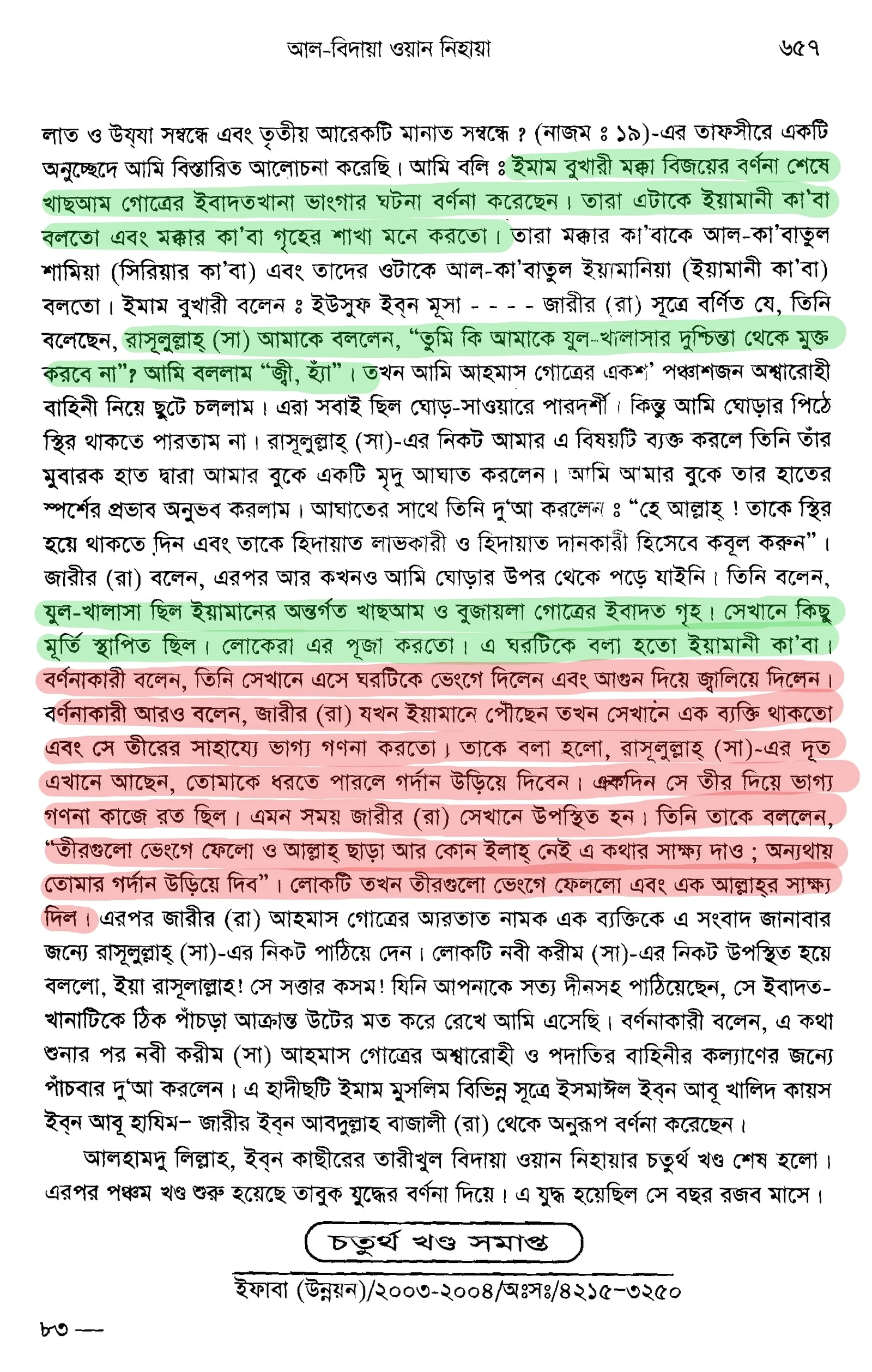
Ibn Kathir also gives important information about the timing of the episode. He discusses Jarir’s conversion as an event after the conquest of Mecca and preserves an account that dates it to 10 AH. The expedition against Dhul Khalasa therefore cannot be placed on the same day or in the same year as the other campaigns to destroy idols that immediately followed the conquest. Ibn Kathir first mentions Dhul Khalasa in passing in his narrative of the conquest of Mecca, then gives a detailed account of the expedition in his account of Jarir’s life. His account makes clear that Dhul Khalasa was destroyed during Muhammad’s lifetime and on his direct orders. (( Al-Bidaya wa-l-Nihaya: Jarir’s Conversion and the Expedition Against Dhul Khalasa ))
Sahih al-Bukhari
Sahih al-Bukhari records the expedition against Dhul Khalasa in the words of Jarir ibn Abd Allah himself. Muhammad ordered him to destroy the “Yemeni Kaaba” of the Khath’am tribe. Jarir took 150 Ahmas horsemen, demolished the sanctuary, and killed those they found there. When they returned and reported what had happened, Muhammad prayed for them. The hadith directly records the destruction of the sanctuary, the killing, and Muhammad’s approval of the expedition. (( Sahih al-Bukhari 3823: The Destruction and Killing at Dhul Khalasa )) (( Sahih al-Bukhari 4355: The Expedition Against Dhul Khalasa ))
In al-Bukhari 3823, Jarir says فَكَسَرْنَا، وَقَتَلْنَا مَنْ وَجَدْنَا عِنْدَهُ: “We broke it down and killed those we found there.” The sentence records both the destruction of the religious building and the killing of people found at the site. It does not give the identities or the number of those killed. (( Sahih al-Bukhari 3823, Original Arabic ))
وَعَنْ قَيْسٍ، عَنْ جَرِيرِ بْنِ عَبْدِ اللَّهِ، قَالَ كَانَ فِي الْجَاهِلِيَّةِ بَيْتٌ يُقَالَ لَهُ ذُو الْخَلَصَةِ، وَكَانَ يُقَالُ لَهُ الْكَعْبَةُ الْيَمَانِيَةُ، أَوِ الْكَعْبَةُ الشَّأْمِيَّةُ، فَقَالَ لِي رَسُولُ اللَّهِ صلى الله عليه وسلم “هَلْ أَنْتَ مُرِيحِي مِنْ ذِي الْخَلَصَةِ”. قَالَ فَنَفَرْتُ إِلَيْهِ فِي خَمْسِينَ وَمِائَةِ فَارِسٍ مِنْ أَحْمَسَ ـ قَالَ ـ فَكَسَرْنَا، وَقَتَلْنَا مَنْ وَجَدْنَا عِنْدَهُ، فَأَتَيْنَاهُ، فَأَخْبَرْنَاهُ، فَدَعَا لَنَا وَلأَحْمَسَ.
English translation: Qays related from Jarir ibn Abd Allah, who said: In the Age of Ignorance, there was a house of worship called Dhul Khalasa. It was also called the Yemeni Kaaba or the Shami Kaaba. Muhammad said to me, “Will you relieve me of Dhul Khalasa?” I set out for it with 150 horsemen of Ahmas. We broke down the sanctuary and killed those we found there. Then we returned to Muhammad and told him what had happened, and he prayed for us and for the Ahmas tribe.
The Islamic Foundation’s Bengali translation of Sahih al-Bukhari, hadith 3549, also records that the temple housing the idol of Dhul Khalasa was destroyed and those found there were killed. (( Sahih al-Bukhari (Islamic Foundation), Hadith 3549 ))
Book: Sahih al-Bukhari (Islamic Foundation)
Book 50: The Prophets (peace be upon them)
Hadith number: 3549
Publisher: Islamic Foundation
Chapter 2131: On Jarir ibn Abd Allah al-Bajali (may Allah be pleased with him)
3549. Ishaq al-Wasiti (may Allah have mercy on him) … It is narrated from Jarir ibn Abd Allah (may Allah be pleased with him), who said: After I embraced Islam, the Messenger of Allah (peace and blessings be upon him) never refused me entry to his house, and whenever he saw me, he smiled. Jarir (may Allah be pleased with him) also said: In the Age of Ignorance there was a house called Dhul Khalasa (a temple of the Khath’am tribe that housed an idol). It was called the Yemeni Kaaba and the Shami Kaaba. The Messenger of Allah (peace and blessings be upon him) said to me, “Can you give me peace concerning Dhul Khalasa?” Jarir (may Allah be pleased with him) said: I set out with 150 horsemen of the Ahmas tribe and destroyed the house that held the idol. We killed those we found there. On my return, I told the Messenger of Allah (peace and blessings be upon him) what had happened. He prayed, greatly pleased, for us and for the Ahmas tribe.
Hadith grade: Sahih (authentic)
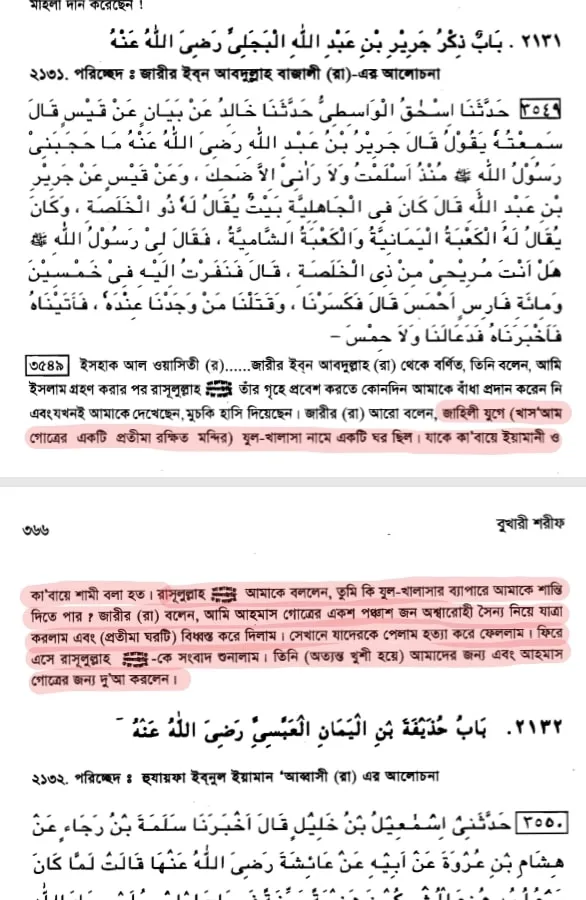
A full account of the military expedition against Dhul Khalasa appears in al-Bukhari 4357. It records the demolition and burning of the sanctuary as well as a direct death threat to put a stop to a local religious practice. When Jarir arrived in Yemen, there was a man there who practised divination with arrows, a familiar religious custom in pre-Islamic Arabia. The man was warned that Muhammad’s envoy was there and would behead him if he caught him. Jarir later confronted the man himself and ordered him to break the arrows and testify that there was no deity but Allah. He told him that if he disobeyed, he would cut off his head. Faced with death, the man broke the arrows and made the Islamic declaration. The episode documents the use of a direct death threat to compel a change of religious belief. The man is given no free choice or voluntary conversion: the two options put to him were to obey Jarir’s orders or face death. (( Sahih al-Bukhari 4357: Breaking the Divining Arrows and Threatening Death to Compel Conversion to Islam ))
Al-Bukhari 4357 records several other details of Jarir’s expedition. After the sanctuary of Dhul Khalasa was burned, a messenger named Abu Artat was sent to Muhammad. He reported that he had left the place as wrecked as a mangy camel. On hearing the news, Muhammad prayed five times for blessings on the cavalry and foot soldiers of Ahmas. (( Sahih al-Bukhari 4357: The Burning of the Sanctuary, the Messenger, and the Five Prayers ))
قَالَ وَكَانَ ذُو الْخَلَصَةِ بَيْتًا بِالْيَمَنِ لِخَثْعَمَ وَبَجِيلَةَ، فِيهِ نُصُبٌ تُعْبَدُ، يُقَالُ لَهُ الْكَعْبَةُ. قَالَ فَأَتَاهَا فَحَرَّقَهَا بِالنَّارِ وَكَسَرَهَا. قَالَ وَلَمَّا قَدِمَ جَرِيرٌ الْيَمَنَ كَانَ بِهَا رَجُلٌ يَسْتَقْسِمُ بِالأَزْلاَمِ فَقِيلَ لَهُ إِنَّ رَسُولَ رَسُولِ اللَّهِ صلى الله عليه وسلم هَا هُنَا فَإِنْ قَدَرَ عَلَيْكَ ضَرَبَ عُنُقَكَ. قَالَ فَبَيْنَمَا هُوَ يَضْرِبُ بِهَا إِذْ وَقَفَ عَلَيْهِ جَرِيرٌ فَقَالَ لَتَكْسِرَنَّهَا وَلَتَشْهَدَنَّ أَنْ لاَ إِلَهَ إِلاَّ اللَّهُ أَوْ لأَضْرِبَنَّ عُنُقَكَ. قَالَ فَكَسَرَهَا وَشَهِدَ، ثُمَّ بَعَثَ جَرِيرٌ رَجُلاً مِنْ أَحْمَسَ يُكْنَى أَبَا أَرْطَاةَ إِلَى النَّبِيِّ صلى الله عليه وسلم يُبَشِّرُهُ بِذَلِكَ، فَلَمَّا أَتَى النَّبِيَّ صلى الله عليه وسلم قَالَ يَا رَسُولَ اللَّهِ وَالَّذِي بَعَثَكَ بِالْحَقِّ مَا جِئْتُ حَتَّى تَرَكْتُهَا كَأَنَّهَا جَمَلٌ أَجْرَبُ. قَالَ فَبَرَّكَ النَّبِيُّ صلى الله عليه وسلم عَلَى خَيْلِ أَحْمَسَ وَرِجَالِهَا خَمْسَ مَرَّاتٍ.
English translation: Jarir said: Dhul Khalasa was a sanctuary in Yemen belonging to Khath’am and Bajila. It contained idols that people worshipped, and it was called the Kaaba. He went there, burned the sanctuary, and broke it down. When Jarir arrived in Yemen, there was a man who practised divination with arrows. He was told, “Muhammad’s envoy is here. If he catches you, he will cut off your head.” One day while the man was casting the arrows, Jarir stood before him and said, “You will break these arrows and testify that there is no deity but Allah, or I will cut off your head.” The man broke the arrows and gave the testimony. Jarir then sent a man of Ahmas named Abu Artat to bring the good news to Muhammad. When Abu Artat reached Muhammad, he said, “By Him who sent you with the truth, I did not come back until I had left it looking like a mangy camel.” Muhammad then prayed five times for blessings on the cavalry and foot soldiers of Ahmas.
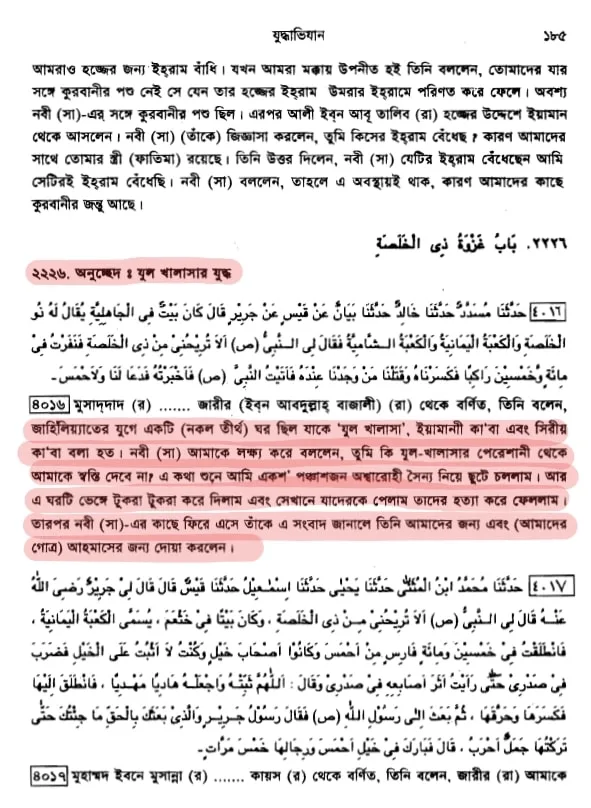
In the Islamic Foundation’s Bengali edition of Sahih al-Bukhari, this long hadith is numbered 4018. It identifies Dhul Khalasa as a pilgrimage site in Yemen belonging to Khath’am and Bajila and preserves the account of the death threat against the man who used arrows for divination. The Bengali translation thus directly records both the destruction of the sanctuary and the suppression of a local religious practice. (( Sahih al-Bukhari, Islamic Foundation, Hadith 4018 ))
Book: Sahih al-Bukhari (Islamic Foundation)
Book 51: Maghazi (Military Expeditions) (كتاب المغازى)
Hadith number: 4018
Publisher: Islamic Foundation
Chapter 2226: The Battle of Dhul Khalasa
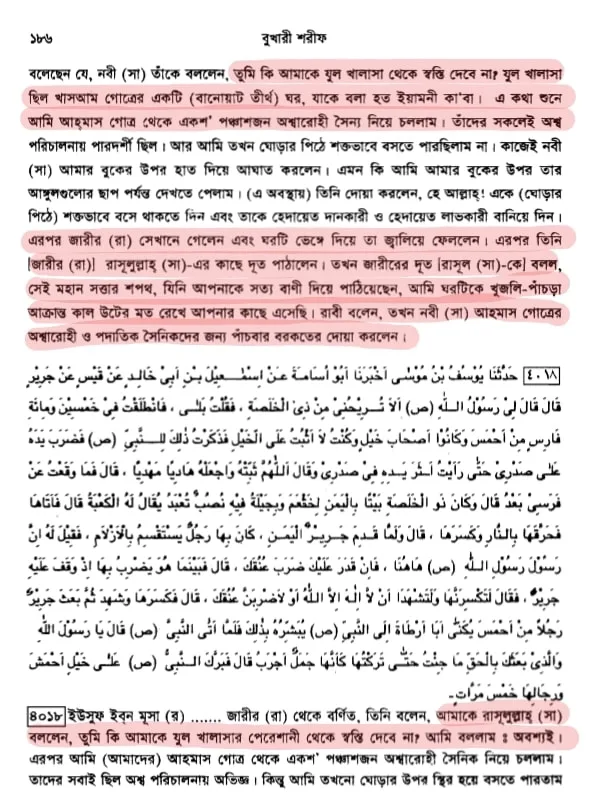
4018. Yusuf ibn Musa (may Allah have mercy on him) … It is narrated from Jarir (may Allah be pleased with him), who said: The Messenger of Allah (peace and blessings be upon him) asked me, “Will you not relieve me of the trouble of Dhul Khalasa?” I said, “Certainly.” I then set out with 150 horsemen of our tribe, Ahmas. They were all experienced riders, but I still could not sit firmly on a horse. I told the Messenger of Allah (peace and blessings be upon him) about it. He struck me on the chest with his hand.
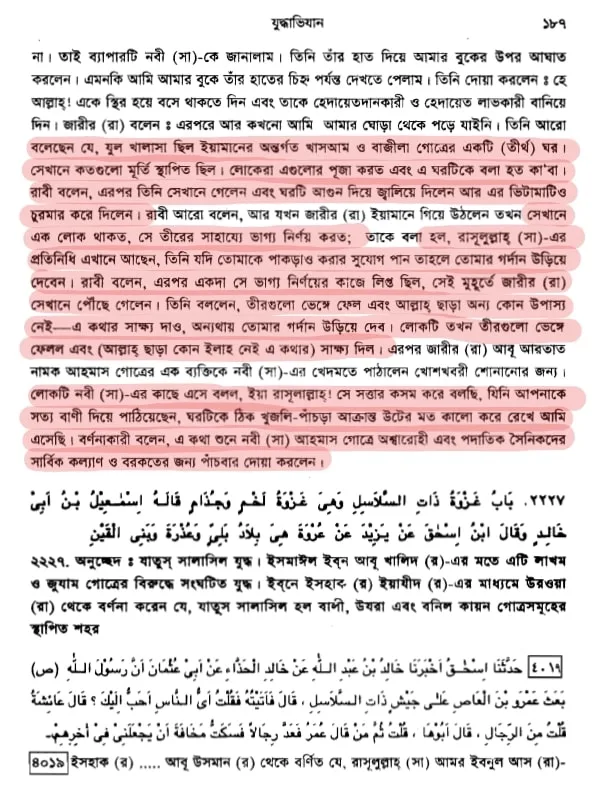
I could even see the mark of his hand on my chest. He prayed, “O Allah, let him sit firmly, make him a guide, and guide him rightly.” Jarir (may Allah be pleased with him) said: After that I never fell off my horse again. He also said that Dhul Khalasa was a pilgrimage house in Yemen belonging to Khath’am and Bajila. Idols had been set up there. The people worshipped them, and the house was called the Kaaba.
The narrator said: He went there, set fire to the house, and razed it to the ground. The narrator added that when Jarir (may Allah be pleased with him) arrived in Yemen, there was a man who told fortunes with arrows. The man was told, “The envoy of the Messenger of Allah (peace and blessings be upon him) is here. If he gets his hands on you, he will cut off your head.”
The narrator said: One day while the man was engaged in divination, Jarir (may Allah be pleased with him) arrived and said, “Break the arrows and testify that there is no deity but Allah, or I will cut off your head.” The man then broke the arrows and testified that there is no deity but Allah. Jarir (may Allah be pleased with him) then sent a man of the Ahmas tribe named Abu Artat to the Messenger of Allah (peace and blessings be upon him) to give him the good news. The man came to the Messenger of Allah (peace and blessings be upon him) and said, “O Messenger of Allah! By Allah, who sent you with the truth, I left the house as black as a camel afflicted with mange.” The narrator said that on hearing this the Messenger of Allah (peace and blessings be upon him) prayed five times for the welfare and blessing of the horsemen and foot soldiers of Ahmas.
Hadith grade: Sahih (authentic)
In the Book of Military Expeditions in Sahih al-Bukhari, the destruction of Dhul Khalasa has its own chapter, “The Expedition Against Dhul Khalasa.” The event also appears in al-Bukhari 3020, in the chapter on burning houses and date palms; in 3076, in the chapter on conveying the good news of victory; and in 3823, in the account of Jarir ibn Abd Allah. Hadiths 4355–4357 appear under the chapter devoted to the expedition itself. This arrangement matters. The destruction of a sanctuary devoted to idol worship was recorded alongside accounts of military operations, the use of fire, news of victory, and the merits of those who took part, rather than merely as a religious dispute or a denunciation of idols. (( Sahih al-Bukhari 3020: The Burning of Houses and Date Palms )) (( Sahih al-Bukhari 3076: News of Victory )) (( Sahih al-Bukhari 4355: The Military Expedition Against Dhul Khalasa ))
Al-Bukhari 4356 also describes Jarir’s difficulty riding a horse and his preparations for the expedition. He could not keep his seat, so Muhammad placed his hand on Jarir’s chest and prayed that he would remain steady. Jarir then took a force of horsemen to destroy the sanctuary. The same account records a prayer for the commander before the expedition and prayers for the troops after its success. (( Sahih al-Bukhari 4356: Jarir’s Preparations for the Expedition ))
Book: Sahih al-Bukhari (Islamic Foundation)
Hadith number: 4017
Book 51: Maghazi (Military Expeditions) (كتاب المغازى)
Publisher: Islamic Foundation
Chapter 2226: The Battle of Dhul Khalasa
4017. Muhammad ibn al-Muthanna (may Allah have mercy on him) … It is narrated from Qays (may Allah have mercy on him), who said: Jarir (may Allah be pleased with him) told me that the Prophet (peace and blessings be upon him) said to him, “Will you not relieve me of Dhul Khalasa?” Dhul Khalasa was a house of the Khath’am tribe, a supposed place of pilgrimage called the Yemeni Kaaba. On hearing this, I set out with 150 horsemen from Ahmas. All were skilled riders, but I could not sit firmly on a horse. The Prophet (peace and blessings be upon him) struck me on the chest with his hand. I could even see the imprints of the Prophet’s blessed fingers on my chest.
He then prayed, “O Allah, let him keep his seat firmly on a horse, make him a guide, and guide him rightly.” Jarir (may Allah be pleased with him) went there, broke down the house, and burned it. He then sent a messenger to the Messenger of Allah (peace and blessings be upon him). Jarir’s messenger said, “By the Exalted One who sent you with the truth, I have come to you after leaving the house like a black camel afflicted with mange.” The narrator said that the Prophet (peace and blessings be upon him) then prayed five times for blessings on the horsemen and foot soldiers of Ahmas.
Hadith grade: Sahih (authentic)
The Bengali edition from Tawhid Publications gives the same account as hadith 4356. It identifies Dhul Khalasa as the “Yemeni Kaaba” and describes the sanctuary being broken down and set on fire. The Arabic words فَكَسَرَهَا وَحَرَّقَهَا mean “he broke it down and burned it.” These two verbs make clear what was done to the sanctuary. The raid went beyond outlawing the idols housed there or preaching a new religion to the local population. It resulted directly in the demolition and burning of the building itself. (( Sahih al-Bukhari 4356, Original Arabic )) (( Sahih al-Bukhari, Tawhid Publications, Hadith 4356 ))
Book: Sahih al-Bukhari (Tawhid)
Hadith number: 4356
Book 64: Maghazi (War)
Publisher: Tawhid Publications
Chapter 64/63: The Battle of Dhul Khalasa
4356. It is narrated from Qays (may Allah have mercy on him). He said: Jarir (may Allah be pleased with him) told me that the Prophet (peace and blessings be upon him) said to him, “Will you not relieve me of Dhul Khalasa?” Dhul Khalasa was a house of the Khath’am tribe, called the Yemeni Kaaba. On hearing this, I set out with 150 horsemen from Ahmas. They were all skilled riders, but I could not keep my seat on a horse. The Prophet (peace and blessings be upon him) struck me on the chest with his hand. I could even see the marks of his fingers on my chest. He prayed, “O Allah, make him steady, make him a guide, and guide him rightly.” Jarir (may Allah be pleased with him) then went there, broke down the house, and burned it. He then sent a messenger to the Messenger of Allah (peace and blessings be upon him). Jarir’s messenger said to the Messenger of Allah (peace and blessings be upon him), “By the Exalted One who sent you with the truth, I left the house like a black camel afflicted with a skin disease and came to you.” The narrator said that the Prophet (peace and blessings be upon him) then prayed five times for blessings on the cavalry and infantry of Ahmas. (3020) (Adhunik Prakashani: 4010; Islamic Foundation: 4014)
Hadith grade: Sahih (authentic)
Sahih Muslim: The Military Expedition Against Dhul Khalasa and the Destruction of the Sanctuary
The Book of the Merits of the Companions in Sahih Muslim preserves Jarir ibn Abd Allah’s expedition against Dhul Khalasa in several versions of hadith 2476. These record that Jarir led the destruction of the sanctuary, that the people found there were killed, that the sanctuary was set on fire, and that news of the victory was brought to Muhammad. Muslim’s collection places these events in the chapter on Jarir’s merits. (( Sahih Muslim 2476a: The Chapter on the Merits of Jarir ibn Abd Allah ))
The Arabic text of Sahih Muslim 2476a says فَكَسَرْنَاهُ وَقَتَلْنَا مَنْ وَجَدْنَا عِنْدَهُ: “We broke it down and killed those we found there.” The force numbered 150 in this version. The same account records the demolition of the sanctuary, the killing, and Muhammad’s subsequent prayers. (( Sahih Muslim 2476a: Arabic Text on the Destruction of the Sanctuary and the Killing ))
فَنَفَرْتُ إِلَيْهِ فِي مِائَةٍ وَخَمْسِينَ مِنْ أَحْمَسَ فَكَسَرْنَاهُ وَقَتَلْنَا مَنْ وَجَدْنَا عِنْدَهُ فَأَتَيْتُهُ فَأَخْبَرْتُهُ فَدَعَا لَنَا وَلأَحْمَسَ
English translation: I set out against it with 150 men from Ahmas. We broke it down and killed those we found there. I then went to Muhammad and told him what had happened. He prayed for us and for Ahmas.
The English translation of this hadith in Sahih Muslim contains serious errors. Sunnah.com gives the narrator of hadith 2476a as Jabir instead of Jarir and the size of the force as 350 instead of 150. Yet the Arabic text displayed on the same page clearly names the narrator as جَرِيرٍ and gives the number of troops as مِائَةٍ وَخَمْسِينَ. The Arabic means 150, not 350. The corresponding report in Sahih al-Bukhari also gives 150. The figure of 350 in the English translation therefore directly contradicts the Arabic text. To determine how many troops took part in the Dhul Khalasa expedition, it is the Arabic original that matters here. Likewise, Jabir and Jarir are two distinct names: the translation has replaced the original narrator with a different person. These are two concrete factual errors, not minor differences in wording. (( Sahih Muslim 2476a: The Arabic Text and English Translation Compared )) (( Sahih al-Bukhari 3823: Jarir Leads 150 Horsemen ))
The Arabic of Sahih Muslim 2476b contains the phrase فَحَرَّقَهَا بِالنَّارِ, “he burned it with fire.” This describes the destruction of the sanctuary itself, beyond the removal of an idol. (( Sahih Muslim 2476b: The Burning of Dhul Khalasa ))
Muslim 2476c gives the full name of the messenger Abu Artat as Husayn ibn Rabi’a. It also notes multiple lines of transmission through Isma’il ibn Abi Khalid. Repeated accounts of the same expedition in al-Bukhari and Muslim do not indicate several separate military campaigns. (( Sahih Muslim 2476c: The Messenger’s Identity and the Chains of Transmission ))
Kitab al-Asnam: Worship, Resistance, and the Destruction of Dhul Khalasa
Ibn al-Kalbi’s Kitab al-Asnam (كتاب الأصنام) preserves descriptions of the gods, idols, temples, ritual objects, offerings, religious poetry, and tribal worship of pre-Islamic Arabia. His account of Dhul Khalasa describes the appearance of the idol, the tribes associated with it, the temple custodians, the armed resistance, and the defeated community’s response. These details establish the sanctuary’s place as a social and religious institution. (( Ibn al-Kalbi, Kitab al-Asnam ))
Ibn al-Kalbi describes idol worship as part of a wider religious system in pre-Islamic Arabia. According to his account, many Meccan households had idols of their own. A person leaving on a journey would touch the household idol before departing, and the first thing he did on his return was to touch it again. Those who could not afford to build a permanent temple or make an idol could set up a stone as a sacred object and circumambulate it. Some travellers collected four stones, chose one as an object of worship, and used the other three to support a cooking pot. When they moved on, they left those stones behind and made similar arrangements in the next place. The account attests both settled and itinerant forms of idol worship. It also shows that in ancient Arabian pagan culture, a stone was more than a building material. Once singled out and declared sacred, it could become a focus of worship, ritual touching, circumambulation, and sacrifice. The white stone of Dhul Khalasa, carved with a crown-like pattern, belonged to this wider religious culture. (( Kitab al-Asnam: Household Idols, Sacred Stones, and Circumambulation Among the Arabs ))
The Arabs used the word dawar (الدوار) for circumambulating sacred stones and idols. According to Ibn al-Kalbi, such stones were called ansab (الأنصاب); idols made in human or other shapes were called asnam and awthan. Stones were set up at different sites and circumambulated in much the same way as the Kaaba in Mecca. Animals were likewise slaughtered before idols and sacred stones. Ibn al-Kalbi records the term ata’ir (العتائر) for the sacrificial animals and atr (العتر) for the place of sacrifice. This vocabulary shows that pre-Islamic Arabian religion had established terms for sanctuaries, idols, circumambulation, sacrificial animals, and offerings. These were established social customs with a religious vocabulary of their own, not isolated or incidental acts. Circumambulation and animal sacrifice at the Meccan Kaaba coexisted with similar rites centred on other idols. Dhul Khalasa was an important regional centre in this system of pilgrimage and worship with its many sacred sites. (( Kitab al-Asnam: Ansab, Asnam, Dawar, Ata’ir, and Pre-Islamic Sacrificial Practices ))
Relations among the local tribes associated with Dhul Khalasa are an important part of the Kitab al-Asnam account. Khath’am, Bajila, Azd al-Sarat, and some nearby groups from Hawazin revered the sanctuary and brought gifts to it. Its upkeep was entrusted to the Banu Umama family of the Bahila tribe. The hereditary assignment of this responsibility gave the sanctuary a lasting institutional structure. For local communities, the idol’s status was part of tribal worship and religious identity, while the Banu Umama served as guardians of the sacred site. Members of several tribes brought gifts to the same sanctuary, but its upkeep remained in the hands of one family, an example of the organised exercise of religious authority in ancient Arabia. The institution endured among these communities because the family’s responsibility for the sanctuary, the right to worship there, and the sanctity of the idol were all socially recognised. (( Ibn al-Kalbi: The Banu Umama Custodians of Dhul Khalasa and the Tribes That Worshipped There ))
Ibn al-Kalbi preserves a poem by Khudash ibn Zuhayr al-Amiri in which an oath invokes both Allah and the sacred white stone of Tabala. The practice of swearing by the deity links the sanctity of Dhul Khalasa to tribal commitments and social relations. The sanctuary was a site of offerings and also had a place in the religious language and poetry of the region. (( Kitab al-Asnam: The Poem of Khudash ibn Zuhayr ))
Ibn al-Kalbi gives a detailed account of the local tribes’ resistance to Jarir’s military expedition against Dhul Khalasa. After Jarir accepted Islam following the conquest of Mecca, Muhammad ordered him to destroy the sanctuary. Jarir arrived with men of the Ahmas tribe. Members of Khath’am and Bahila fought his forces to defend the sanctuary. Ibn al-Kalbi writes that 100 Bahila custodians were killed and that there was extensive killing among Khath’am as well. He specifically records the deaths of 200 members of the Banu Quhafa ibn Amir branch of Khath’am. His account records both armed resistance in defence of the sanctuary and the suppression of that resistance. On the numbers he gives, 300 people were reportedly killed in these two groups alone. Sahih al-Bukhari and Sahih Muslim record the killings without giving these numbers. The specific figures appear in Ibn al-Kalbi’s historical account. (( Ibn al-Kalbi, Kitab al-Asnam: Khath’am and Bahila’s Defence of Dhul Khalasa and the Account of Those Killed ))
فَقَاتَلَتْهُ خَثْعَمٌ وَبَاهِلَةُ دُونَهُ فَقَتَلَ مِنْ سَدَنَتِهِ مِنْ بَاهِلَةَ يَوْمَئِذٍ مِائَةَ رَجُلٍ وَأَكْثَرَ الْقَتْلَ فِي خَثْعَمٍ
English translation: The men of Khath’am and Bahila fought him to defend Dhul Khalasa. That day he killed a hundred of the Bahila custodians and killed many among Khath’am.
Ibn al-Kalbi also quotes a poem attributed to a woman of Khath’am after the destruction of Dhul Khalasa. It speaks of the defeat of the temple’s defenders and the humiliation of the women of Khath’am at the hands of the Ahmas warriors. The poem expresses the social cost of the fighting from the defeated community’s point of view. Alongside the victors’ accounts, it gives voice to the humiliation and anger of people who lost their sanctuary. (( Kitab al-Asnam: A Khath’am Woman’s Poem After the Destruction of Dhul Khalasa ))
قَسَمَ الْمَذَلَّةَ بَيْنَ نِسْوَةِ خَثْعَمٍ فِتْيَانُ أَحْمَسَ قِسْمَةً تَشْعِيبَا
English translation: The young men of Ahmas spread humiliation and disgrace among the women of Khath’am.
Ibn al-Kalbi says that Jarir defeated the defenders of Dhul Khalasa, demolished the sanctuary, and set it on fire. His expression hadama bunyana (هدم بنيان) refers to the demolition of the sanctuary’s structure. The attack went beyond forbidding worship of the idol: it destroyed the building itself. The place where people of different tribes had gathered to perform rites around a sacred stone was torn down. As a result, the temple, the institution that maintained it, and the facilities for communal worship could no longer serve their former purpose. The destruction of the site disrupted the local tribes’ ability to practise their religion independently. A regional sanctuary with a standing comparable to that of a Kaaba lost its former religious identity. (( Ibn al-Kalbi: The Demolition and Burning of the Sanctuary of Dhul Khalasa ))
Ibn Hisham’s Sira: The Worshippers of Dhul Khalasa, Divination, and the Religious Culture of Ancient Arabia
Ibn Hisham’s Al-Sira al-Nabawiyya has a chapter drawing on Ibn Ishaq, titled ذو الخلصة وسدنته وهدمه, “Dhul Khalasa, Its Custodians, and Its Destruction.” It records the sanctuary’s ties to Daws, Khath’am, Bajila, and other communities around Tabala. The same source preserves an account of consulting the deity through divining arrows and a poem rejecting the result. (( Ibn Hisham, Al-Sira al-Nabawiyya: Dhul Khalasa and Its Custodians ))
In one account of divination at Dhul Khalasa, a man seeks the god’s permission to avenge the murder of his father. The arrows tell him to refrain. He rejects their verdict and addresses the deity in verse, saying that Dhul Khalasa would not have forbidden revenge had his own father been killed. The story records both the practice of seeking divine approval for a personal decision and the willingness to reproach the deity when the answer was unwelcome. (( Ibn Hisham: Divination at Dhul Khalasa and the Poem About Revenge ))
قَالَ ابْنُ إِسْحَاقَ: وَكَانَ ذُو الْخَلَصَةِ لِدَوْسٍ وَخَثْعَمَ وَبَجِيلَةَ، وَمَنْ كَانَ بِبِلَادِهِمْ مِنَ الْعَرَبِ بِتَبَالَةَ.
قَالَ ابْنُ هِشَامٍ: وَيُقَالُ: ذُو الْخُلُصَةِ.
قَالَ رَجُلٌ مِنَ الْعَرَبِ:
لَوْ كُنْتَ يَا ذَا الْخُلُصِ الْمَوْتُورَا
مِثْلِي وَكَانَ شَيْخُكَ الْمَقْبُورَا
لَمْ تَنْهَ عَنْ قَتْلِ الْعُدَاةِ زُورَا
قَالَ: وَكَانَ أَبُوهُ قُتِلَ، فَأَرَادَ الطَّلَبَ بِثَأْرِهِ، فَأَتَى ذَا الْخَلَصَةِ، فَاسْتَقْسَمَ عِنْدَهُ بِالْأَزْلَامِ، فَخَرَجَ السَّهْمُ بِنَهْيِهِ عَنْ ذَلِكَ، فَقَالَ هَذِهِ الْأَبْيَاتَ. وَمِنَ النَّاسِ مَنْ يَنْحَلُهَا امْرَأَ الْقَيْسِ بْنَ حُجْرٍ الْكِنْدِيَّ. فَبَعَثَ إِلَيْهِ رَسُولُ اللَّهِ صَلَّى اللَّهُ عَلَيْهِ وَسَلَّمَ جَرِيرَ بْنَ عَبْدِ اللَّهِ الْبَجَلِيَّ فَهَدَمَهُ.
English translation: Ibn Ishaq said: Dhul Khalasa was the sanctuary of Daws, Khath’am, Bajila, and other Arabs living in the region of Tabala. Ibn Hisham said that it was also called Dhul Khulasa. An Arab man said: “O Dhul Khalasa! Had you been waiting for vengeance as I am, and had your father also been laid in the grave, you would not have forbidden the unjust killing of the enemies.” The narrator said that the man’s father had been killed and that he wanted to avenge his father’s murder. He went to Dhul Khalasa and consulted the divining arrows. The result told him to refrain from revenge. He then composed these verses. Some have attributed them to Imru’ al-Qays ibn Hujr al-Kindi. Muhammad later sent Jarir ibn Abd Allah al-Bajali against Dhul Khalasa, and he demolished it.
Ibn Hisham first attributes the poem to an unnamed Arab and then says that some ascribe it to Imru’ al-Qays ibn Hujr al-Kindi. The Sira preserves both attributions. The story of divination at Dhul Khalasa and of a worshipper rejecting the deity’s verdict found its way into ancient Arabian religious poetry.
The azlam were also part of pagan religious practice at the Meccan Kaaba. In Sahih al-Bukhari 1601, Ibn Abbas reports that at the conquest of Mecca, images of Abraham and Ishmael holding divining arrows were found in the Kaaba. Muhammad ordered the images removed and denied that Abraham or Ishmael had used the arrows in this way. The practice of consulting azlam at Dhul Khalasa and the presence of images holding them at the Meccan Kaaba show how widespread these objects were in Arabian religious life. (( Sahih al-Bukhari 1601: Images Holding Divining Arrows in the Kaaba ))
عَنِ ابْنِ عَبَّاسٍ ـ رَضِيَ اللَّهُ عَنْهُمَا ـ قَالَ إِنَّ رَسُولَ اللَّهِ صلى الله عليه وسلم لَمَّا قَدِمَ أَبَى أَنْ يَدْخُلَ الْبَيْتَ وَفِيهِ الآلِهَةُ فَأَمَرَ بِهَا فَأُخْرِجَتْ فَأَخْرَجُوا صُورَةَ إِبْرَاهِيمَ وَإِسْمَاعِيلَ فِي أَيْدِيهِمَا الأَزْلاَمُ فَقَالَ رَسُولُ اللَّهِ صلى الله عليه وسلم ” قَاتَلَهُمُ اللَّهُ أَمَا وَاللَّهِ قَدْ عَلِمُوا أَنَّهُمَا لَمْ يَسْتَقْسِمَا بِهَا قَطُّ ”. فَدَخَلَ الْبَيْتَ، فَكَبَّرَ فِي نَوَاحِيهِ، وَلَمْ يُصَلِّ فِيهِ.
English translation: Ibn Abbas said: When Muhammad arrived in Mecca, he refused to enter the Kaaba while there were idols inside. He ordered them removed, and they were taken out. The people then brought out images of Abraham and Ishmael with divining arrows in their hands. Muhammad said, “May Allah destroy them! By Allah, they knew full well that Abraham and Ishmael never used these arrows for divination.” Muhammad then entered the Kaaba and proclaimed Allah’s greatness in its corners, but did not pray inside.
Verses 3 and 90 of Surah al-Ma’ida also refer to the azlam, the ansab, and the sacrificial practices of earlier Arabia. Quran 5:3 prohibits animals sacrificed at idols or sacred altars and the use of divining arrows to make decisions. Quran 5:90 condemns wine, gambling, sacred idols or altars, and divining arrows as the work of Satan. These verses show the wider religious context directly relevant to worship at Dhul Khalasa. The Quran banned the pre-Islamic customs of slaughtering animals at sacred stones and using arrows to seek a deity’s decision. At the same time, the Meccan Kaaba, circumambulation, Hajj, and animal sacrifice survived as elements of a religion practised in the name of Allah. The earlier religious culture thus met two different fates: selected rites were retained under a new religious identity, while rival deities and the rites performed in their names were outlawed and suppressed. (( Quran, Surah al-Ma’ida 5:3 )) (( Quran, Surah al-Ma’ida 5:90 ))
يَا أَيُّهَا الَّذِينَ آمَنُوا إِنَّمَا الْخَمْرُ وَالْمَيْسِرُ وَالْأَنْصَابُ وَالْأَزْلَامُ رِجْسٌ مِنْ عَمَلِ الشَّيْطَانِ فَاجْتَنِبُوهُ لَعَلَّكُمْ تُفْلِحُونَ
English translation: O believers! Wine, gambling, idols or sacrificial altars, and divining arrows are indeed abominations of Satan’s making. Shun them so that you may succeed. (Surah al-Ma’ida 5:90)
Fath al-Bari: The Religious Authority of Dhul Khalasa, the Military Order, and the Purpose of Destroying the Temple
In Fath al-Bari, his commentary on Sahih al-Bukhari, Ibn Hajar al-Asqalani discusses the name and location of Dhul Khalasa, the identity of the sanctuary, the reasons Jarir was sent against it, and the differing reports of how many troops took part. He notes that Dhul Khalasa sometimes refers to the house of worship and sometimes to the idol inside it. “Khalasa” is also the name of a plant with red fruit like beads of agate. (( Ibn Hajar, Fath al-Bari, “باب غزوة ذي الخلصة” ))
In discussing the identity of Dhul Khalasa, Ibn Hajar preserves another important historical detail. According to the Arabic philologist al-Mubarrad, the former site of the sanctuary later became the congregational mosque of al-Abalat, a town of the Khath’am tribe. This gives another picture of the religious changes that followed the sanctuary’s destruction. The old sacred site was not forgotten; it became associated with a new religious building. Ibn al-Kalbi reports that the stone of Dhul Khalasa was used as the threshold of a mosque, while Ibn Hajar preserves al-Mubarrad’s report that the former sanctuary site became a congregational mosque. These accounts record how a new Islamic religious institution took over the site and the material of the earlier worship. The place remained identifiable, but the worship of its former deity and the religious authority associated with it came to an end. (( Fath al-Bari: The Location of Dhul Khalasa and Al-Mubarrad’s Account of the Congregational Mosque ))
وَالْخَلَصَةُ نَبَاتٌ لَهُ حَبٌّ أَحْمَرُ كَخَرَزِ الْعَقِيقِ، وَذُو الْخَلَصَةِ اسْمٌ لِلْبَيْتِ الَّذِي كَانَ فِيهِ الصَّنَمُ، وَقِيلَ اسْمُ الْبَيْتِ الْخَلَصَةُ وَاسْمُ الصَّنَمِ ذُو الْخَلَصَةِ، وَحَكَى الْمُبَرِّدُ أَنَّ مَوْضِعَ ذِي الْخَلَصَةِ صَارَ مَسْجِدًا جَامِعًا لِبَلْدَةٍ يُقَالُ لَهَا الْعَبَلَاتُ مِنْ أَرْضِ خَثْعَمَ، وَوَهَّمَ مَنْ قَالَ إِنَّهُ كَانَ فِي بِلَادِ فَارِسَ.
English translation: Khalasa is the name of a plant with red fruit like beads of agate. Dhul Khalasa was the name of the house of worship in which the idol stood. It has also been said that the house was called Khalasa and the idol Dhul Khalasa. Al-Mubarrad reports that the site of Dhul Khalasa later became a congregational mosque in a town of Khath’am called al-Abalat. He says that those who placed Dhul Khalasa in Persia were mistaken.
Fath al-Bari also discusses whether the Dhul Khalasa worshipped by Daws was the same as the Kaaba-like Dhul Khalasa of Khath’am. Drawing on Ibn Dihya, Ibn Hajar says that Amr ibn Luhayy set up an idol called al-Khalasa in lower Mecca. People offered garlands and ostrich eggs and slaughtered animals there. The Dhul Khalasa of Khath’am was a sanctuary built to resemble the Kaaba. Ibn Hajar regards the case for distinguishing the two as strong. (( Fath al-Bari: The Dhul Khalasa of Daws and That of Khath’am ))
وَذَكَرَ ابْنُ دِحْيَةَ أَنَّ ذَا الْخَلَصَةِ الْمُرَادَ فِي حَدِيثِ أَبِي هُرَيْرَةَ كَانَ عَمْرُو بْنُ لُحَيٍّ قَدْ نَصَبَهُ أَسْفَلَ مَكَّةَ، وَكَانُوا يُلْبِسُونَهُ الْقَلَائِدَ وَيَجْعَلُونَ عَلَيْهِ بَيْضَ النَّعَامِ وَيَذْبَحُونَ عِنْدَهُ، وَأَمَّا الَّذِي لِخَثْعَمَ فَكَانُوا قَدْ بَنَوْا بَيْتًا يُضَاهُونَ بِهِ الْكَعْبَةَ فَظَهَرَ الِافْتِرَاقُ وَقَوِيَ التَّعَدُّدُ، وَاللَّهُ أَعْلَمُ.
English translation: Ibn Dihya stated that the Dhul Khalasa mentioned in Abu Hurayra’s hadith was the idol that Amr ibn Luhayy set up in lower Mecca. People put garlands on it, placed ostrich eggs on it, and slaughtered animals before it. As for the Dhul Khalasa of Khath’am, they had built a sanctuary resembling the Kaaba in Mecca. The distinction between the two thus became apparent, and the case that there were separate sanctuaries became stronger.
Ibn Hajar explains Muhammad’s words أَلَا تُرِيحُنِي مِنْ ذِي الْخَلَصَةِ, “Will you not relieve me of Dhul Khalasa?”, as a request that carried the force of an order. He says Jarir was given the task because the sanctuary stood in the territory of his tribe and he was one of its prominent men. In Ibn Hajar’s reading, the continued worship of a deity other than Allah was a source of distress to Muhammad. (( Fath al-Bari: The Order to Destroy Dhul Khalasa and Jarir’s Standing in His Tribe ))
قَوْلُهُ: (أَلَا تُرِيحُنِي) هُوَ بِتَخْفِيفِ اللَّامِ طَلَبٌ يَتَضَمَّنُ الْأَمْرَ وَخَصَّ جَرِيرًا بِذَلِكَ لِأَنَّهَا كَانَتْ فِي بِلَادِ قَوْمِهِ وَكَانَ هُوَ مِنْ أَشْرَافِهِمْ، وَالْمُرَادُ بِالرَّاحَةِ رَاحَةُ الْقَلْبِ، وَمَا كَانَ شَيْءٌ أَتْعَبَ لِقَلْبِ النَّبِيِّ صَلَّى اللَّهُ عَلَيْهِ وَسَلَّمَ مِنْ بَقَاءِ مَا يُشْرَكُ بِهِ مِنْ دُونِ اللَّهِ تَعَالَى.
English translation: “Will you not relieve me?” is a request that carries the force of an order. Jarir was singled out for this task because the sanctuary was in the territory of his people and he was a man of standing among them. “Relief” here means relief of the heart. Nothing distressed the Prophet’s heart more than the continued worship of anything other than Allah.
Ibn Hajar preserves a further order from al-Hakim’s Al-Iklil, through al-Bara ibn Azib. In this account, after Khath’am refused to accept Islam, Muhammad sent another 300 of the Ansar with Jarir and ordered him to call on the tribe to accept Islam for three days. If they accepted, he was to accept their conversion and destroy the idol of Dhul Khalasa. If they refused, he was to use the sword. In this version, imposing religious allegiance and removing the former deity were two objectives of the same expedition. (( Fath al-Bari: The Three-Day Call to Islam and the Military Order, as Reported by al-Hakim ))
فَسَأَلَهُ عَنْ بَنِي خَثْعَمَ فَأَخْبَرَهُ أَنَّهُمْ أَبَوْا أَنْ يُجِيبُوا إِلَى الْإِسْلَامِ، فَاسْتَعْمَلَهُ عَلَى عَامَّةِ مَنْ كَانَ مَعَهُ، وَنَدَبَ مَعَهُ ثَلَاثَمِائَةٍ مِنَ الْأَنْصَارِ، وَأَمَرَهُ أَنْ يَسِيرَ إِلَى خَثْعَمَ فَيَدْعُوهُمْ ثَلَاثَةَ أَيَّامٍ، فَإِنْ أَجَابُوا إِلَى الْإِسْلَامِ قَبِلَ مِنْهُمْ وَهَدَمَ صَنَمَهُمْ ذَا الْخَلَصَةِ، وَإِلَّا وَضَعَ فِيهِمُ السَّيْفَ.
English translation: Muhammad asked about the tribe of Khath’am. Jarir told him that they had refused the call to accept Islam. Muhammad put Jarir in command of the people who were with him and assigned a further 300 Ansar to join him. He told Jarir to go to Khath’am and call on them to accept Islam for three days. If they accepted Islam, their conversion was to be accepted and their idol, Dhul Khalasa, destroyed. Otherwise, the sword was to be used against them.
Fath al-Bari preserves further historical accounts about the number of troops who took part. The familiar version in Sahih al-Bukhari gives Jarir 150 horsemen from Ahmas. Ibn Hajar says that a weak report in al-Tabarani gives a figure of 700. In Ibn al-Sakan’s Kitab al-Sahaba, Qays ibn Gharaba al-Ahmasi describes a larger force, with troops who arrived under other leaders and men from the Ansar in addition to Jarir’s own contingent. In discussing the different figures, Ibn Hajar considers whether the horsemen of Jarir’s own tribe and the other troops were counted separately. Later historical sources thus record the involvement of supporting forces as well as a small body of horsemen. The numbers differ, but the accounts consistently describe an organised military expedition against Dhul Khalasa. (( Fath al-Bari: The 150 Horsemen, Al-Tabarani’s Figure of 700, and Ibn al-Sakan’s Account of Additional Troops ))
Sharh Sahih Muslim: The Yemeni and Shami Kaabas and the Religious Standing of Separate Pilgrimage Sites
In his Sharh Sahih Muslim, al-Nawawi explains the names “Yemeni Kaaba” and “Shami Kaaba.” In his account, Dhul Khalasa was a Kaaba-like sanctuary in Yemen, and “Shami Kaaba” distinguished the Kaaba in Mecca from it. The Islamic commentarial tradition thus preserves the fact that a sanctuary outside Mecca was also called a Kaaba. (( Al-Nawawi, Sharh Sahih Muslim: The Yemeni and Shami Kaabas ))
Al-Nawawi reads the two names as referring to two separate sacred houses: the Yemeni Kaaba was Dhul Khalasa, and the Shami Kaaba was the Kaaba in Mecca. These geographic terms served to distinguish the two sites. (( Sharh Sahih Muslim: The Names of the Two Kaabas ))
وَالْمُرَادُ أَنَّ ذَا الْخَلَصَةَ كَانُوا يُسَمُّونَهَا الْكَعْبَةَ الْيَمَانِيَّةَ، وَكَانَتِ الْكَعْبَةُ الْكَرِيمَةُ الَّتِي بِمَكَّةَ تُسَمَّى الْكَعْبَةَ الشَّامِيَّةَ، فَفَرَّقُوا بَيْنَهُمَا لِلتَّمْيِيزِ.
English translation: The meaning is that they called Dhul Khalasa the Yemeni Kaaba and the Kaaba in Mecca the Shami Kaaba. They used these names to distinguish the two sanctuaries from one another.
Versions of Sahih Muslim differ as to whether there is a conjunction between “Yemeni Kaaba” and “Shami Kaaba.” In discussing the variant, al-Nawawi explains that the two names designate separate sanctuaries. (( Al-Nawawi: The Variant Readings of the Two Kaaba Names ))
Qadi Iyad regarded the wording that linked “Shami Kaaba” to Dhul Khalasa as an error in transmission. Al-Nawawi rejected that conclusion and explained the two names in relation to one another. The disagreement concerns whether the wording gives two names to the same sanctuary. (( Sharh Sahih Muslim: The Readings of Qadi Iyad and Al-Nawawi ))
Al-Nawawi also records several pronunciations of the name Dhul Khalasa. He notes variations in the vowels on the Arabic letters kha and lam in “Khalasa.” Qadi Iyad also mentions these variants. Their preservation in Islamic literature and the tradition of transmission shows how long the name remained in circulation. It was used for the sanctuary, for the idol worshipped there, and for the associated site. These different uses illuminate the relationship between a sacred place and the object of worship. A sanctuary built around an idol can take the name of the deity it houses, and that name can then come to identify the whole pilgrimage site. In the case of Dhul Khalasa, the names of the idol, the sanctuary, and the regional sacred site were intertwined. (( Al-Nawawi: The Pronunciation of Dhul Khalasa and the Identity of the Sanctuary ))
In explaining the account of Dhul Khalasa being burned black, al-Nawawi treats the destruction of the sanctuary as an example of “striking at the traces of falsehood” and going to great lengths to remove it. He also draws a rule from Jarir’s dispatch of a messenger: it is commendable to send someone to bring the good news of a military victory or a similar event. The news of victory from which al-Nawawi draws this rule was news that another religion’s sanctuary had been demolished and burned. (( Al-Nawawi, Sharh Sahih Muslim: The Destruction of Dhul Khalasa and the Good News of Victory ))
وفيه النكاية بآثار الباطل، والمبالغة في إزالته. وفي هذا الحديث استحباب إرسال البشير بالفتوح ونحوها.
English translation: This shows striking at the traces of falsehood and going to great lengths to remove it. The hadith also shows that it is commendable to send a bearer of good news about victories and similar events.
The Prophecy of Renewed Pagan Worship at Dhul Khalasa: The Women of Daws and the Return to the Religion of Their Ancestors
In Sahih al-Bukhari 7116, Abu Hurayra reports that Muhammad predicted that women of the Daws tribe would circumambulate Dhul Khalasa before the Day of Judgment. The account identifies Dhul Khalasa as an object of pre-Islamic worship among Daws. Al-Bukhari places the hadith in the chapter on the return to idol worship. (( Sahih al-Bukhari 7116: The Women of Daws Circumambulating Dhul Khalasa ))
لاَ تَقُومُ السَّاعَةُ حَتَّى تَضْطَرِبَ أَلَيَاتُ نِسَاءِ دَوْسٍ عَلَى ذِي الْخَلَصَةِ. وَذُو الْخَلَصَةَ طَاغِيَةُ دَوْسٍ الَّتِي كَانُوا يَعْبُدُونَ فِي الْجَاهِلِيَّةِ.
English translation: The Hour will not come until the buttocks of the women of Daws sway at Dhul Khalasa. Dhul Khalasa was the deity that Daws worshipped in the Age of Ignorance.
The Arabic word أَلَيَات in the hadith is the plural of أَلْيَة, meaning “buttocks.” The verb تَضْطَرِبَ means to sway or move. By describing the movement of the buttocks of the women of Daws, Muhammad’s words evoke their physical movement around the sanctuary. Explaining these words in his Sharh Sahih Muslim, al-Nawawi makes clear that the women would sway as they circumambulated Dhul Khalasa. The particular act of worship in the prophecy is thus circumambulation of the idol or sacred site. The women of Daws are said to return to the former practice of idol worship by performing this rite. The explanation matters because it identifies the same kind of circumambulation in the prophecy as in the older worship at Dhul Khalasa. (( Al-Nawawi, Sharh Sahih Muslim, Volume 18, pp. 353–354: Circumambulation at Dhul Khalasa ))
وَالْمُرَادُ يَضْطَرِبْنَ مِنَ الطَّوَافِ حَوْلَ ذِي الْخَلَصَةِ، أَيْ يَكْفُرُونَ وَيَرْجِعُونَ إِلَى عِبَادَةِ الْأَصْنَامِ وَتَعْظِيمِهَا.
English translation: This means that the women will sway as they circumambulate Dhul Khalasa. In other words, they will return to unbelief and go back to worshipping and venerating idols.
In Sahih Muslim 2906, the same prophecy uses the phrase حَوْلَ ذِي الْخَلَصَةِ, “around Dhul Khalasa.” At the end of the account, Dhul Khalasa is identified as an idol worshipped by the Daws tribe at Tabala. The tribe, the idol, the place, and the rite of circumambulation appear together in this version. (( Sahih Muslim 2906: The Idol at Tabala and the Prophecy of Circumambulation ))
لاَ تَقُومُ السَّاعَةُ حَتَّى تَضْطَرِبَ أَلَيَاتُ نِسَاءِ دَوْسٍ حَوْلَ ذِي الْخَلَصَةِ. وَكَانَتْ صَنَمًا تَعْبُدُهَا دَوْسٌ فِي الْجَاهِلِيَّةِ بِتَبَالَةَ.
English translation: The Hour will not come until the buttocks of the women of Daws sway around Dhul Khalasa. It was an idol at Tabala that the people of Daws worshipped in the Age of Ignorance.
Immediately after the prophecy of renewed worship at Dhul Khalasa, Sahih Muslim preserves another important hadith. In hadith 2907, Aisha reports that Muhammad said night and day would not cease until the worship of al-Lat and al-Uzza had resumed. Al-Lat and al-Uzza were two of the best-known goddesses of pre-Islamic Arabia, and their sanctuaries were destroyed in Muhammad’s lifetime. The prophecy is thus not limited to one tribal deity at Dhul Khalasa. It also speaks of a return to the worship of other major pagan deities of Arabia. The appearance of both Dhul Khalasa and the future worship of al-Lat and al-Uzza in the same chapter shows that the return of earlier Arabian paganism is a recognised theme in Islamic accounts of the end times. (( Sahih Muslim 2907a: The Prophecy of Renewed Worship of Al-Lat and Al-Uzza ))
لاَ يَذْهَبُ اللَّيْلُ وَالنَّهَارُ حَتَّى تُعْبَدَ اللاَّتُ وَالْعُزَّى.
English translation: Night and day will not cease until al-Lat and al-Uzza are worshipped again.
In this hadith, Aisha puts a pointed question to Muhammad. Quran 9:33 says that Allah sent his messenger with the true religion to make it prevail over all other religions. Aisha had understood the verse to mean that this victory would last. Hearing Muhammad speak of a return to the worship of al-Lat and al-Uzza, she asks how the prophecy fits that understanding. Muhammad replies that the state of affairs will last as long as Allah wishes. Then a fragrant wind will be sent, and even those with the smallest amount of faith in their hearts will die. People in whom there is no good will remain and return to the religion of their ancestors. In this account, the future end of Islamic religious authority and the return to ancestral pagan worship are part of the same sequence. (( Sahih Muslim 2907a: Aisha’s Question, Quran 9:33, and the Return to the Religion of the Ancestors )) (( Quran, Surah al-Tawba 9:33 ))
The accounts of a return to the worship of Dhul Khalasa, al-Lat, and al-Uzza are religious prophecies about the end times. They preserve the names of earlier Arabian deities and the rite of circumambulation. These hadiths do not record whether the sanctuaries were in fact rebuilt at any specific later time. They are important for understanding the presence of an earlier religious culture and how it was remembered in Islam.
Other Hadiths and Historical Works: The Order to Destroy Dhul Khalasa and Variants of the Expedition Account
Beyond Sahih al-Bukhari and Sahih Muslim, accounts of the Dhul Khalasa expedition appear in Sunan Abi Dawud, Musnad Ahmad, Sahih Ibn Hibban, Musnad al-Humaydi, Al-Sunan al-Kubra of al-Nasa’i, and Ibn Sa’d’s Al-Tabaqat al-Kubra. These sources preserve variants in the number of troops and prayers, as well as details of the expedition’s banner, the conversion of a tribal delegation to Islam, and how the idol was burned.
Hadith 2772 in Sunan Abi Dawud appears in the Book of Jihad, under “Sending Bearers of Good News.” Jarir ibn Abd Allah relates that Muhammad asked him to relieve him of Dhul Khalasa. Jarir went there, set fire to the sanctuary, and then sent a man from Ahmas named Abu Artat to bring Muhammad the good news. The placement of the report in Abu Dawud’s collection matters. The destruction of a place of worship is presented as news of a successful military operation. The Arabic يُبَشِّرُهُ means “to bring him good news.” The burning of a sanctuary in an expedition Muhammad had ordered was news to be welcomed. The dispatch of a dedicated messenger to report the outcome also shows the importance attached to the expedition. (( Sunan Abi Dawud 2772, Book of Jihad, باب في بعثة البشراء ))
In Sahih Ibn Hibban 7202, Muhammad tells Jarir that none of the taghuts of the Age of Ignorance remains except the sanctuary of Dhul Khalasa. He then orders Jarir to deal with it. The account places the attack on Dhul Khalasa within a series of destructions of pagan sanctuaries. (( Sahih Ibn Hibban 7202: The Remaining Sanctuary of Dhul Khalasa ))
يَا جَرِيرُ، إِنَّهُ لَمْ يَبْقَ مِنْ طَوَاغِيتِ الْجَاهِلِيَّةِ إِلَّا بَيْتُ ذِي الْخَلَصَةِ، فَاكْفِينِهِ
English translation: O Jarir! None of the taghuts of the Age of Ignorance remains except the sanctuary of Dhul Khalasa. Deal with it for me.
This report in Sahih Ibn Hibban mentions 170 horsemen with Jarir. Musnad Ahmad 19188 gives the same number. The familiar accounts in al-Bukhari and Muslim give Jarir 150 horsemen. In Musnad Ahmad, Dhul Khalasa is the Yemeni Kaaba of the Khath’am tribe, and Jarir sends word of the victory after setting the sanctuary on fire. Ibn Hibban adds that the sanctuary was the surviving taghut of the Age of Ignorance. Both collections transmit the account through Isma’il ibn Abi Khalid, Qays ibn Abi Hazim, and Jarir ibn Abd Allah. Its appearance in different books therefore does not amount to testimony from entirely separate eyewitnesses. The differences between the versions still matter: although the size of the force differs, both record Muhammad’s order, the destruction and burning of the sanctuary, and the dispatch of news of the expedition’s success. (( Musnad Ahmad 19188 and Sahih Ibn Hibban 7202: The Arabic Texts and Their Troop Counts Compared ))
Musnad al-Humaydi 820 preserves another version of the same expedition. The transmitter Sufyan ibn Uyayna says that Jarir took forty or fifty riders. This account records the burning of Dhul Khalasa and says that Muhammad prayed three times for the cavalry and foot soldiers of Ahmas after the expedition. The longer accounts in al-Bukhari and Muslim give five prayers. Al-Humaydi also preserves the narrator’s uncertainty about the size of the force: he could not say for certain whether the original figure was forty or fifty. The variation rules out claiming that every account gives the same number of troops. This version still records both the burning of Dhul Khalasa and Muhammad’s blessing after the expedition. (( Musnad al-Humaydi 820: Forty or Fifty Riders and Three Prayers ))
Al-Sunan al-Kubra of al-Nasa’i, hadith 8245, and al-Tabarani’s Al-Mu’jam al-Kabir also record the expedition. Al-Nasa’i gives a figure of 150 horsemen and reports Muhammad’s prayer after Jarir told him he could not stay on a horse. One account in al-Tabarani describes the expedition’s victory and the burning of the sanctuary; another gives a larger number of troops. The hadith collections thus preserve the broad sequence while differing over the size of the force, the number of prayers, and specific details of the events. The accounts make the military character of Jarir’s expedition clearer still when read alongside Ibn Sa’d’s account of the tribal delegation and the presentation of a military banner. (( Al-Sunan al-Kubra of al-Nasa’i 8245 )) (( Al-Tabarani, Al-Mu’jam al-Kabir 2255 ))
Ibn Sa’d’s account of the arrival of the Bajila delegation in Al-Tabaqat al-Kubra places Dhul Khalasa in a wider political and military context. According to his account, Jarir ibn Abd Allah arrived in Medina in 10 AH with 150 men from his tribe and accepted Islam before Muhammad. He pledged allegiance to Muhammad. The pledge covered adherence to Islamic beliefs and rites, as well as obedience to the ruler. Qays ibn Azra of Ahmas is said to have arrived in Medina at the same time with 250 men. When Muhammad asked who they were, they called themselves “the Ahmas of Allah.” The conversion of a regional tribal leader like Jarir made it possible to deploy the horsemen with him under the new political and religious leadership. The expedition against Dhul Khalasa was an important expression of this change in allegiance. (( Ibn Sa’d, Al-Tabaqat al-Kubra, “وفد بجيلة”: The Arrival of Jarir and the Ahmas in 10 AH ))
In Ibn Sa’d’s account, Muhammad asked Jarir about the progress of conversion to Islam and the destruction of idols in his region. Jarir said that the tribes had destroyed their idols and that the call to prayer and the mosques had been established. Dhul Khalasa still stood as before. Muhammad ordered Jarir to destroy it and gave him a banner for the expedition. The conversation records how Dhul Khalasa was singled out after other places of worship had been removed. (( Al-Tabaqat al-Kubra: The Destruction of Idols and the Banner for the Dhul Khalasa Expedition ))
وَهَدَّمَتِ الْقَبَائِلُ أَصْنَامَهَا الَّتِي كَانَتْ تُعْبَدُ، قَالَ: فَمَا فَعَلَ ذُو الْخَلَصَةِ؟ قَالَ: هُوَ عَلَى حَالِهِ قَدْ بَقِيَ
English translation: The tribes had destroyed the idols they used to worship. Muhammad then asked, “What of Dhul Khalasa?” Jarir replied, “It still stands as it was.”
Another lengthy report in Ibn Sa’d gives more detail on Jarir’s preparations and how the sanctuary was destroyed. Jarir says that the people of Ahmas had been skilled riders since before Islam. They carried out attacks on horseback and used horses to defend themselves when attacked. Jarir himself could not keep his seat. After Muhammad prayed for him, he set out for Dhul Khalasa with his cavalry. In this account, Jarir encountered a group of pagans when he reached the sanctuary. Confident in its sanctity, they asked whether the Muslim force could really destroy it. Jarir answered them, obtained fire, and told the troops to gather dry grass from the surrounding area. They then set fire to the grass and burned the sanctuary and the idol’s covering. This account gives a concrete detail about the method of destruction: dry vegetation from around the sanctuary was used to spread the fire. (( Ibn Sa’d, Al-Tabaqat al-Kubra: The Longer Account of Jarir’s Expedition, the Horsemen, and the Method of Burning ))
One version in Ibn Sa’d says that about 200 men took part in the expedition and that they met no resistance when they destroyed the sanctuary. Ibn al-Kalbi’s Kitab al-Asnam records armed resistance by Khath’am and Bahila and many deaths. The two accounts differ on the nature of the resistance and the loss of life. The version in Ibn Sa’d is transmitted through Muhammad ibn Umar al-Waqidi. Al-Bukhari and Muslim record the destruction of the sanctuary and the killing but give no death toll. The sources thus differ about the resistance and the number killed. (( Ibn Sa’d: The Account in Which the Expedition Met No Resistance )) (( Ibn al-Kalbi: Resistance and the Number Killed ))
The Aftermath of Dhul Khalasa’s Destruction: The End of an Older Pilgrimage Tradition and the Concentration of Religious Authority at the Meccan Kaaba
Writing about the fate of the idol of Dhul Khalasa, Ibn al-Kalbi says that in his day the stone served as the threshold of a mosque in Tabala. A stone once worshipped as a deity became building material for a new place of worship. Islamic history itself records how the idol lost its former sacred status. (( Kitab al-Asnam: The Fate of the Stone of Dhul Khalasa ))
وَذُو الْخَلَصَةِ الْيَوْمَ عَتَبَةُ بَابِ مَسْجِدِ تَبَالَةَ.
English translation: Dhul Khalasa now serves as the threshold of the mosque door at Tabala.
Muhammad dealt differently with the Kaaba in Mecca. Al-Bukhari records that at the conquest of Mecca, the 360 idols or stones worshipped around the Kaaba were removed, and idols and images inside it were taken out. The Kaaba itself was left standing and remained the principal pilgrimage site of Islam. The sanctuary of Dhul Khalasa, by contrast, was torn down and burned. (( Sahih al-Bukhari 4287: The Removal of the Idols at the Kaaba )) (( Sahih al-Bukhari 4288: The Removal of Idols from Inside the Kaaba ))
Surah al-Tawba 9:17–19 also makes the upkeep of places of worship a matter of religious identity. Verse 17 denies polytheists the right to maintain the mosques of Allah. The next verse reserves that role for those who believe in Allah and the Last Day, establish prayer, give zakat, and fear none but Allah. Verse 19 refuses to put established pilgrimage services such as giving pilgrims water and maintaining the Sacred Mosque on a par with faith and jihad in the cause of Allah. The Kaaba and selected pilgrimage rites were retained, while the right to maintain the sacred site was made conditional on the new religious identity. (( Quran, Surah al-Tawba 9:17–19 ))
9:17 مَا كَانَ لِلْمُشْرِكِينَ أَن يَعْمُرُوا مَسَاجِدَ اللَّهِ شَاهِدِينَ عَلَىٰ أَنفُسِهِم بِالْكُفْرِ ۚ أُولَٰئِكَ حَبِطَتْ أَعْمَالُهُمْ وَفِي النَّارِ هُمْ خَالِدُونَ
9:18 إِنَّمَا يَعْمُرُ مَسَاجِدَ اللَّهِ مَنْ آمَنَ بِاللَّهِ وَالْيَوْمِ الْآخِرِ وَأَقَامَ الصَّلَاةَ وَآتَى الزَّكَاةَ وَلَمْ يَخْشَ إِلَّا اللَّهَ ۖ فَعَسَىٰ أُولَٰئِكَ أَن يَكُونُوا مِنَ الْمُهْتَدِينَ
9:19 أَجَعَلْتُمْ سِقَايَةَ الْحَاجِّ وَعِمَارَةَ الْمَسْجِدِ الْحَرَامِ كَمَنْ آمَنَ بِاللَّهِ وَالْيَوْمِ الْآخِرِ وَجَاهَدَ فِي سَبِيلِ اللَّهِ ۚ لَا يَسْتَوُونَ عِندَ اللَّهِ ۗ وَاللَّهُ لَا يَهْدِي الْقَوْمَ الظَّالِمِينَ
English translation:
9:17 Polytheists have no right to maintain Allah’s mosques while bearing witness against themselves to their unbelief. Their deeds have come to nothing, and they will remain in the Fire forever.
9:18 Only those who believe in Allah and the Last Day, establish prayer, give zakat, and fear none but Allah maintain the mosques of Allah. It is they who may be among the rightly guided.
9:19 Do you make giving pilgrims water and maintaining the Sacred Mosque equal to the deeds of one who believes in Allah and the Last Day and wages jihad in Allah’s cause? They are not equal before Allah. Allah does not guide wrongdoers.
Quran 9:28 calls polytheists “najas,” or impure, and forbids them to approach the Sacred Mosque. The verse acknowledges the fear of financial loss from the ban and answers it with a promise that Allah will provide wealth out of his bounty. The relationship between pagan pilgrimage to Mecca and commerce is part of the verse’s social context. (( Quran, Surah al-Tawba 9:28 ))
إِنَّمَا الْمُشْرِكُونَ نَجَسٌ فَلَا يَقْرَبُوا الْمَسْجِدَ الْحَرَامَ بَعْدَ عَامِهِمْ هَٰذَا
English translation: The polytheists are indeed impure. So after this year they must not approach the Sacred Mosque. (Excerpt from Surah al-Tawba 9:28)
In his commentary on Surah al-Tawba 9:28, Ibn Kathir discusses the economic question in more detail. He says that after the verse was revealed in 9 AH, the order to keep polytheists away from the Sacred Mosque was enforced. Some people feared that excluding pagan pilgrims would harm their markets and trade. Ibn Kathir preserves Ibn Ishaq’s account of those fears. He explains that the money subsequently collected through the jizya was understood to replace the commercial benefits that had been lost. The account makes clear how closely the old Meccan pilgrimage system tied religion to the economy. The arrival of different communities for Hajj was a religious occasion as well as a time for markets and trade, on which people’s livelihoods depended. Excluding the former pagan pilgrims changed that relationship. The transfer of religious authority over the Kaaba thus also reshaped the economy of the old pilgrimage culture. (( Tafsir Ibn Kathir on Surah al-Tawba 9:28: The Exclusion of Polytheists, Fears for Markets and Trade, and the Jizya ))
لَتَنْقَطِعَنَّ عَنَّا الْأَسْوَاقُ، وَلَتَهْلِكَنَّ التِّجَارَةُ
English translation: Our markets will close, and trade will perish.
The destruction of Dhul Khalasa raises a moral question about the safety of places of worship and freedom of religion. Local communities worshipped their own deity, gathered there, and cared for their sacred site. In an expedition ordered by Muhammad, the sanctuary was torn down and burned, and people were killed. Al-Bukhari also records that a man who practised divination was forced under threat of death to make an Islamic declaration. The use of military force and individual coercion to end another religion’s worship is a direct violation of religious freedom.
Conclusion
The destruction of Dhul Khalasa was no voluntary conversion or natural decline of an abandoned sanctuary. On Muhammad’s orders, Jarir ibn Abd Allah took a force there, tore down the sanctuary, set it on fire, and killed those they found at the site. In another account in al-Bukhari, Jarir threatens to behead a man who practises divination unless he breaks his arrows and makes the Islamic declaration. Ibn al-Kalbi describes the resistance of the temple’s defenders and extensive loss of life. Muhammad prayed for the troops after the expedition. Islam’s own principal sources record the destruction of idols, the burning of a place of worship, the killing, and the use of a death threat to end a religious practice.
The Kaaba in Mecca was an established pilgrimage site in pre-Islamic Arabia. Muhammad removed its idols but preserved the structure and selected rites of the familiar Hajj. In the years after the conquest of Mecca, pagans were barred from Hajj and regional Kaaba-like sanctuaries such as Dhul Khalasa were destroyed. These events played a direct role in replacing the sacred sites and religious institutions of different Arabian tribes with Islamic authority centred on the Meccan Kaaba.
Even if the religious beliefs of the worshippers of Dhul Khalasa were wrong or unfounded, that does not justify demolishing their sanctuary, burning their idol, or killing people. Every community has the right to worship according to its own beliefs and preserve its cultural heritage. Protecting one religion’s sanctuary while destroying another’s is a discriminatory denial of that right. Dhul Khalasa is a direct example of organised military violence and forced conversion used to establish religious authority.
Several aphorisms from Humayun Azad’s Prabachanaguchchha speak to the destruction of mosques and temples and to violence in the name of establishing religious authority:
It is the religious who demolish mosques, and the religious who demolish temples. They still claim to be religious, while those who take no part in the demolition are called irreligious or atheists.
Allah is unaffected when a mosque is demolished, and Bhagavan is unaffected when a temple is demolished. Only the religious fanatics care. They are the ones who demolish mosques and temples.
Building and tearing down mosques is politics. Tearing down and building temples is politics. Yet they carry it out in the name of religion.
When mosques and temples are demolished, one truth stands out: how inactive, how absent, Allah and Bhagavan are.